From Worksheets, To Wonder
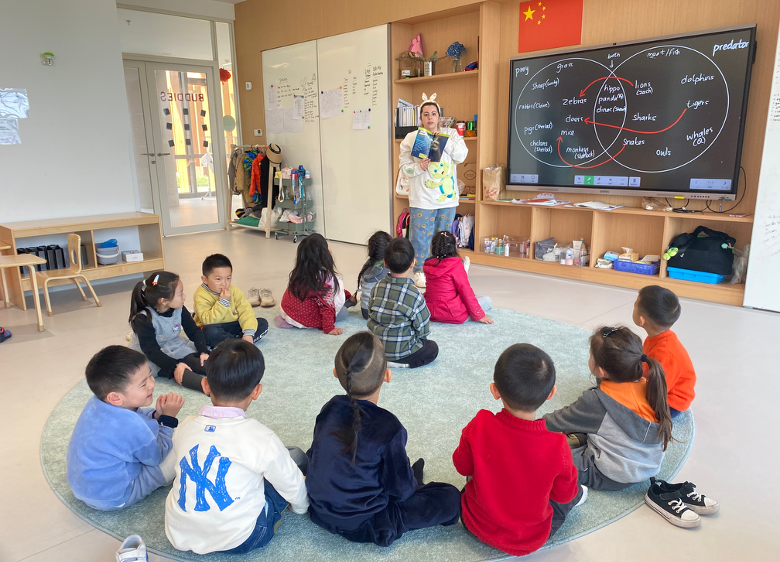
For a long time, my world in education revolved around structure. At EF, I was used to clear curriculum maps, measurable targets, and knowing exactly where children were expected to be by the end of a unit, term, or level. There was comfort in that clarity. As an ESL teacher—and later in leadership roles—I learned how to scaffold language, differentiate instruction, and help students progress toward very specific outcomes.
But somewhere along the way, I started to feel curious about what existed outside of that model.
I had become increasingly aware of other philosophies and approaches to teaching and learning, particularly within Early Years education. I found myself reading more about inquiry, play, child agency, and holistic development. I wanted to understand what learning looked like when it wasn’t driven solely by language acquisition or fixed academic targets. I wanted to explore environments where curiosity led the learning rather than simply supporting it.
That curiosity eventually led me to HEI Schools, and honestly, I fell in love.
Their philosophy of whole-child, child-centered education completely shifted my perspective. The environments felt calm, intentional, and respectful of children in a way I hadn’t fully experienced before. Learning wasn’t rushed. There was value placed on creativity, collaboration, emotional development, independence, and wonder. It made me rethink what meaningful learning could actually look like for young children.
Ironically, the seeds of this transition had already started growing while I was still at EF.
At the time, I had begun piloting an inquiry-based program for our Early Years students. I was fascinated by the idea of moving away from overly scripted lessons and toward more open-ended exploration. But implementing inquiry with very young ESL learners came with challenges I hadn’t anticipated.
Writing open-ended questions for three- and four-year-olds is already difficult.
Writing open-ended questions for children learning English as an additional language? Even harder.
I remember sitting with Chinese-speaking colleagues trying to translate inquiry questions while still preserving their meaning and intent. A question that sounded rich and thought-provoking in English could suddenly become too leading, too abstract, or completely confusing once translated. We spent hours discussing wording, simplifying concepts, and figuring out how to make inquiry accessible without losing its depth.
And honestly? I loved that challenge.
It pushed me to think more deeply about language, cognition, and how children construct understanding. It also forced me to slow down and really observe children—not just what they could say, but what they were wondering, noticing, building, and trying to communicate in non-verbal ways.
Around this time, I also applied for my Master’s in Education. It felt like the natural next step in my professional evolution. I wanted to better understand pedagogy, curriculum theory, and the research behind the approaches I was becoming so passionate about.
Then came the next major leap: joining a bilingual school as founding faculty.
That experience changed everything.
The school had its own philosophy and identity, but from the beginning, there was a genuine commitment to creating a positive, holistic Early Years environment. The classrooms were Reggio-inspired—beautiful, intentional spaces filled with natural materials, provocations, loose parts, documentation, and opportunities for exploration. The environment itself felt like a teacher.
I remember walking into the classrooms for the first time and feeling excited in a way I hadn’t felt in years.
There was possibility everywhere.
We used planning approaches that, at the time, I didn’t fully realize were heavily connected to the IB PYP. Looking back now, I can clearly see those influences. We used collaborative mind maps to explore all the possible directions learning could take. We mapped teacher questions, student questions, potential provocations, vocabulary, transdisciplinary links, and opportunities for exploration.
And the most exciting part?
The plans weren’t fixed.
The curriculum was emergent.
That was both liberating and terrifying.
In my previous teaching experiences, planning often meant delivering content efficiently and effectively. But emergent curriculum required something entirely different. It demanded observation. Documentation. Flexibility. Patience. Collaboration. Humility.
Sometimes we would spend days observing children before deciding where to take the learning next. A simple student comment about shadows could evolve into a two-week investigation involving light, projection, storytelling, measurement, and art. A child bringing in a snail from the playground could suddenly spark conversations about habitats, movement, responsibility, and living things.
The children genuinely shaped the direction of learning.
Of course, that also meant things didn’t always go to plan.
There were moments where carefully prepared provocations completely flopped. Times where children became fascinated by something none of us had anticipated. Discussions that went wildly off track. Projects that became beautifully messy. But those moments taught me more about authentic learning than any scripted curriculum ever could.
I also came to value the collaboration required within the homeroom team deeply.
Meaningful emergent curriculum cannot happen in isolation.
It takes constant communication between teachers, assistants, and specialists. It requires shared observation, reflective discussion, and collective decision-making. Some of the most impactful professional conversations I’ve ever had happened sitting around documentation panels, reviewing children’s work, debating next steps, and trying to interpret what the children were really communicating through their play and interactions.
That period of my career fundamentally changed how I view education.
It taught me that learning doesn’t always need to be linear to be meaningful. Children are capable of extraordinary thinking when given time, trust, and space. That curriculum can be responsive without losing intentionality. And that teaching is often less about controlling outcomes and more about designing environments where curiosity can thrive.
Looking back now, I don’t see my transition away from EF as abandoning one approach for another. Instead, I see it as an expansion.
My ESL background gave me structure, adaptability, differentiation skills, and a deep understanding of communication and scaffolding. Inquiry-based Early Years education gave me a new lens—one rooted in observation, relationships, creativity, and child agency.
Together, those experiences shaped the educator and leader I am today.